
₦524bn Ondo 2026 Budget Targets Consolidation, Growth – Akindolire
The Ondo State Commissioner for Economic Planning and Budget, Mr Olaolu Akindolire, has outlined the major components of the 2026 Appropriation Law, describing it as a strategic, realistic and people-centred fiscal plan aimed at consolidating earlier gains and addressing prevailing economic realities.
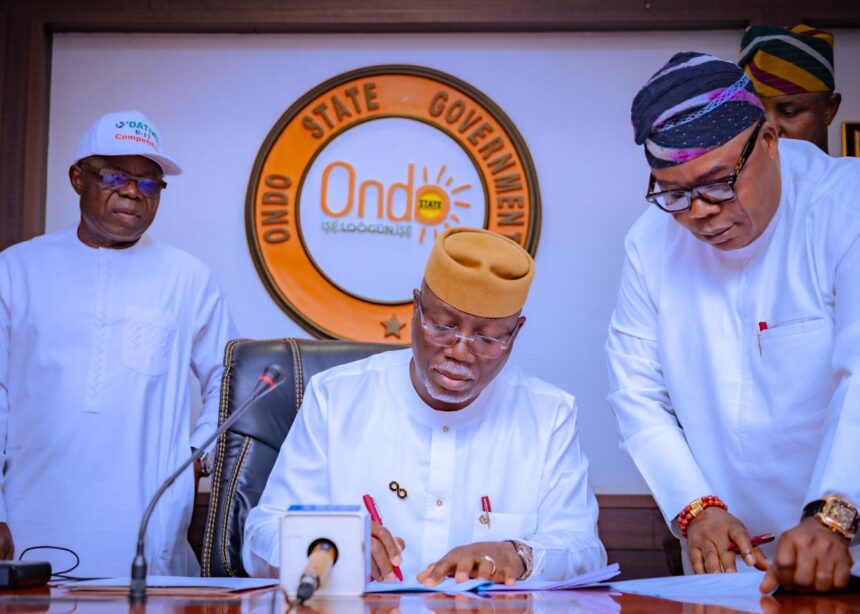
Akindolire spoke during the signing of the budget at the EXCO Chamber, Governor’s Office, Akure.
The Commissioner disclosed that the total size of the 2026 Budget stands at ₦524.41 billion, noting that it is anchored on the Budget of Economic Consolidation framework. He explained that the budget is structured to strengthen fiscal sustainability, reduce economic vulnerabilities and ensure the long-term resilience of the state’s economy.
According to the commissioner, the revenue framework projects ₦238.53 billion from federal transfers (FAAC receipts), ₦44.79 billion from Internally Generated Revenue (IGR), and ₦6.05 billion from grants and aid.
He added that the state plans to raise ₦72.92 billion through local and foreign borrowings, including loans from development partners, stressing that such borrowings would be strictly tied to capital and growth-enhancing projects.
Akindolire further revealed that recurrent expenditure for the 2026 fiscal year is estimated at ₦220.83 billion, representing 42.11 per cent of the total budget.
He said this allocation would cover personnel costs, overheads and the provision of essential public services required for the effective functioning of government.
On capital expenditure, he said the government has earmarked ₦303.58 billion, representing 57.89 per cent of the total budget size. He noted that this reflects the administration’s strong commitment to infrastructure development and long-term economic growth.
Breaking down sectoral allocations, Akindolire stated that infrastructural development received the largest share, with ₦144.48 billion, representing 27.6 per cent of the total budget, targeted at road construction and other critical public infrastructure.
He said the education sector was allocated ₦64.57 billion (12.3 per cent) to advance human capital development, while the health sector received ₦59.54 billion (11.4 per cent) to improve healthcare delivery and strengthen health outcomes across the state.
He added that the public finance sector was allocated ₦95.11 billion, representing 18.1 per cent of the budget, to ensure effective fiscal coordination and meet debt obligations. Agricultural development received ₦29.67 billion (5.7 per cent) to boost food security, agro-research and rural value chains.
According to the commissioner, general administration was allocated ₦35.25 billion (6.7 per cent), while the administration of justice received ₦20.58 billion (3.9 per cent). Community development was allocated ₦16.37 billion (3.1 per cent), regional development received ₦15.51 billion (3.0 per cent), and legislative administration was provided with ₦13.01 billion (2.5 per cent).
Other key sectors, including trade and industry, environment and sewage management, energy and information, also received targeted allocations to support economic growth, environmental sustainability and public wellbeing.
Describing the 2026 Budget as more than a fiscal document, Akindolire said it represents a social contract between the government and the people of Ondo State.
He called for strong collaboration among the executive and legislative arms, ministries, departments and agencies, the private sector, civil society organisations and development partners to ensure effective implementation.
He reaffirmed the government’s commitment to value-for-money spending, transparency and robust monitoring, while expressing appreciation to all stakeholders for their contributions and support.
He expressed confidence that the successful implementation of the budget would deliver tangible benefits to the people of Ondo State.
While signing the budget, the State Governor, Dr Lucky Orimisan Aiyedatiwa, described the occasion as far more than a statutory requirement, calling it “a solemn reaffirmation of our collective commitment to the progress, stability and sustainable development of our beloved Sunshine State”.
Governor Aiyedatiwa said the 2026 Budget of Economic Consolidation is a strategic blueprint designed to respond effectively to prevailing national economic realities while positioning Ondo State on a path of self-reliance, resilience and enduring prosperity.
He outlined the sectoral distribution, noting allocations to agricultural development, trade and industry, education, health, information, community development, infrastructural development, environment and sewage management, regional development, administration of justice, public finance, general administration, legislative administration and energy.
Governor Aiyedatiwa highlighted the budget’s key pillars, emphasising agriculture and food security through targeted investments in modern farming, support for smallholder farmers and improved access to credit.
He stressed human capital development and skills enhancement through education, school renovations, teacher training and digital skills development.
He added that economic transformation and infrastructure development, including the completion and initiation of critical projects in roads, power and water supply, would create an enabling environment for businesses.
He also affirmed the ongoing drive to expand internally generated revenue through technology-driven, transparent tax systems, expansion of the revenue base and the blocking of revenue leakages.
On his part, the Speaker of the Ondo State House of Assembly, Rt Hon. Olamide Oladiji, commended Governor Aiyedatiwa for transforming the state and giving Akure a capital-city appearance.
He also highlighted the House’s achievements in passing bills regulating community activities, prohibiting kidnapping, registering domestic staff, establishing the State Road Fund and creating coastal and waterways management agencies.



