


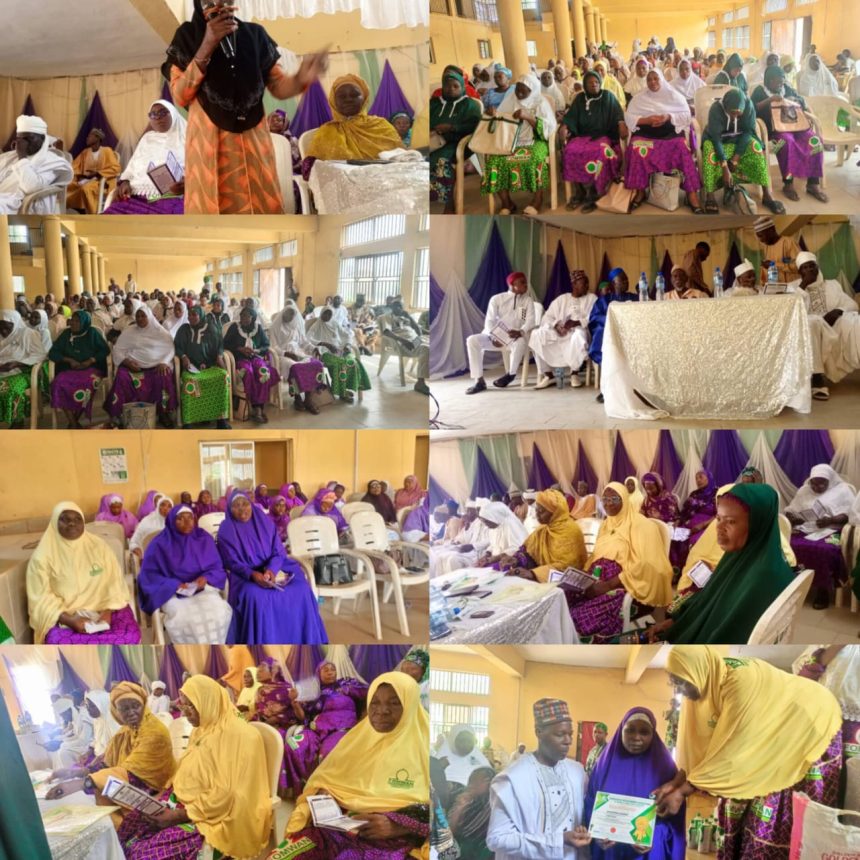
Oke-Agbe Inauguration: Scholar Charges FOMWAN Executives on Accountability, Justice
The inauguration of new executives of the Federation of Muslim Women’s Associations in Nigeria (FOMWAN) in Oke-Agbe was marked with a thought-provoking lecture on “Leadership and Accountability in Islam” delivered by renowned Islamic scholar, Alhaja Dr. Sidiqot Shodehinde.
Speaking to a gathering of Muslim women leaders, community members, and invited guests, Dr. Shodehinde described leadership as a divine trust ordained by Almighty Allah. She referenced Qur’an 2:30, where Allah declared His intention to place a vicegerent on earth, explaining that leadership was established by Allah even before the descent of humankind to guide and manage creation responsibly.
According to the scholar, leadership goes beyond holding an official position. She defined it as the ability to influence, motivate, and inspire others towards a common goal, while guiding, directing, and empowering people.
She identified two forms of leadership: formal leadership, such as managerial roles in corporate organizations, and informal leadership, which emerges within communities where individuals are entrusted with authority by consensus.
Dr. Shodehinde emphasized that Islam views leadership as a collective responsibility. Citing several hadiths of Prophet Muhammad (SAW), she reminded the audience that everyone is a leader in one capacity or another and will be held accountable by Allah for those under their care.
She quoted the hadith which states that every individual is a shepherd responsible for their flock, underscoring leadership as a trust (Amanah).
She further noted that Islamic leadership is rooted in service, justice, and fairness. “A leader in Islam is a servant to the people,” she said, stressing that leaders must prioritize the welfare of their followers and rule with equity. She added that the best leaders are those who love their people and are loved in return, as highlighted in the teachings of the Prophet (SAW).
Outlining key attributes of an ideal Islamic leader, Dr. Shodehinde listed Taqwa (consciousness and fear of Allah), Adl (justice), Shura (consultation), and Rahmah (compassion).
She urged the newly inaugurated FOMWAN executives to embody these qualities in their leadership roles.
In the second part of her lecture, the scholar focused on accountability, describing it as being answerable for one’s actions, decisions, and performance.
She explained that accountability enhances leadership effectiveness by improving performance, building trust, encouraging sound decision-making, and fostering personal growth.
According to her, accountability also promotes fairness, ensures that actions have consequences, and sets a positive example that nurtures a culture of responsibility within organizations and communities.
The lecture concluded with a charge to the new FOMWAN leaders to see their positions as a sacred trust from Allah and to lead with integrity, humility, and a deep sense of responsibility, both to the people they serve and to Allah.
A goodwill message was also delivered by the Alafin of Afinland, Prof. Abdul Raheem.
Earlier in her welcome address, the State Amirah, Alhaja Medinat Omikunle, appreciated participants for gracing the occasion and reminded them of the need to be good ambassadors of Islam at all times.
In her acceptance speech, the new Oke-Agbe FOMWAN leader, Alhaja Sulaiman Saidat, promised to work in unity with her team to move the association to greater heights.


