

Media Rights Agenda (MRA) has called on Nigerian Journalists to make effective use of the Freedom of Information Act which has been signed into law over 12 years ago.
It said, effective use of the Act will make their work easier and more safer in the course of discharging their professional duties.
The Executive Director of Media Rights Agenda, Mr. Edetaen Ojo gave the charge at a workshop held on Tuesday and Wednesday in Ibadan, Oyo State on using the Freedom of Information Act for investigative reporting.
The two days training organised by the Media Right Agenda under the Collaborative Media Engagement for Development, Inclusion and Accountability (CMEDIA) project which was supported by Mac Arthur Foundation through Woke Soyinka Centre for Investigative Journalism drew journalists from across the Southwest states to further sensitise journalists on the Freedom of information Act and it’s use for investigative report on public institutions.
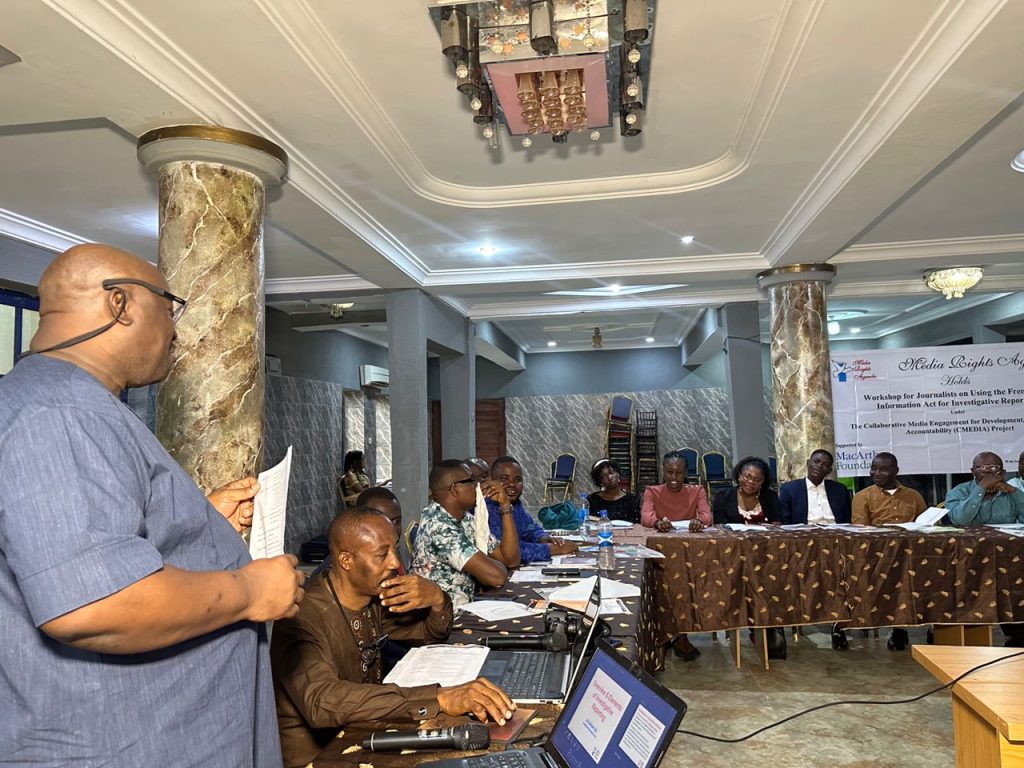
Speaking at the event, Mr Ojo observed the varied situation of the public institution where a number of some institutions have been very responsive to request and disclosing information while majority of others are very secretive and reluctant to give out such information.
” We have a number of Public institutions that are typically ranked very high in the degree of and publication of information proactively while a large number of institutions have remained at the bottom of ranking and we keep trying to encourage them that they need to do better,” he said.
The Media Rights Agency , he said believed that the federal government needs to put in some efforts in ensuring that those institutions comply as he tasked journalists in raising public awareness and pressurising government to recognise the obligations to disclose information for public consumption.

Journalists, he said must ensure that public institutions comply with the law, noting that refusal to comply attracts government sanctioning them because non compliance is a breach and violation of the law which is punishable.
Ojo who affirmed a reporter’s job in digging up and making investigation known to the people, advised them to rely more on the freedom of information Act for effective investigation.
In a brief interview, the Executive Director identified some areas which are not very progressive in the act like no provision requiring government to undertake public enlightenment to ensure that members of the society are familiar with the law and are using it.
He also raised the issue of the oversight mechanism in the law where the Attorney General of the federation could be an independent body rather than being dependent as the case is in Nigeria.
He charged government to intensify efforts in ensuring that public institutions comply to the act as he expressed the role of journalists in raising public awareness and pressuring government to recognise the obligations of disseminating information to journalists and citizens.
The training featured some resource persons presentation of several papers among which included; Understanding the Freedom of Information Act, 2021 by Mr Ayode Alonge , Fact checking and investigative Reporting by Esther Adeniyi, making request for information Under FOI Act by Dr Obioma Okonkwo , Usage of the freedom of Information Act, and a lot of others.
Participants appreciated the Media Rights Agenda for the training which they said will enhance their professionalism.



